Space debris: how an astronaut’s discarded glove could cause havoc

astronaut-astronomy-cosmonaut-355956.jpg

Clearing up our rubbish

It seems that wherever humans go they will always leave behind their rubbish and space is no exception to this rather depressing fact. Over 60 years of space activity has resulted in a great deal of space debris being left behind to float aimlessly in orbit around the Earth.

Current estimates indicate that there are almost 130 million objects in space of various shapes and sizes, ranging in size from a few millimetres to many metres and they can all prove hazardous. Amongst it all is known to be a glove lost by astronaut Ed White on the first American space-walk back in 1965. Even something as tiny as a fleck of paint, too small to be tracked, has the potential, when travelling at speeds of up to 17,500 mph, to cause damage. A number of space shuttle windows have had to be replaced because of paint fleck damage. And that’s just the small stuff.

Over 900,000 objects are considered big enough to damage or completely destroy entire spacecraft should they be involved in a collision. Objects like old satellites, spent rocket stages and fragments caused by their disintegration and collisions. In 2009, a defunct Russian satellite collided with and destroyed a functioning U.S. commercial satellite. The collision caused an extra 2,000 pieces of trackable debris to be added to the existing inventory of space rubbish.

NASA has well-established rules for tracking and dealing with possible collisions with such objects, including the most major of these, the evacuation of a space station. Debris avoidance manoeuvres are planned according to the probability of collision and the impact to mission objectives and risk to the crew. Over the last 10 years several collision avoidance manoeuvres have been conducted.

However the problem is not going to go away, in fact it will only get worse as more and more bits of space junk are added to what’s already up there. The only answer is to get rid of it. And that’s exactly what a 100kg satellite called RemoveDebris UK has been doing, by trialling a number of technologies that could be used in the future to deal with the clear up of space debris. The tests, using a harpoon and nets, have been successful and could open the door to a solution to the problem.

Simon Fellowes, from the Surrey Space Centre and manager of the consortium behind RemoveDebris said this, “As a university, we’ve given proof of concept for the basic ideas; we’ve shown the technology-readiness has reached a certain level. It’s now for industry to turn these concepts into a commercial product or business.”

Let’s hope that someone heeds his words and takes action before the very real prospect of space tourism becomes the norm, because that amount of debris floating about on the space highways is an accident waiting to happen.



Wasps: what are they for?

wasps

Ruining the last days of summer or gardener’s friend?

The only person I’ve ever come across who has openly admitted to liking wasps is naturalist Chris Packham. When asked by a young person, “What are wasps for?”, he started his reply by saying – ‘I’m a great fan of wasps. I have a nest of them in my stables and they’re very happy; I’m very happy.’

However, anyone who has ever attempted to enjoy a cream tea, in the garden, on a sunny late summer afternoon, will understand why I simply can’t bring myself to agree with him. The minute you uncover that jam to put on your scone, be it in the Cornish or Devon way, it doesn’t matter, you are going to be plagued by wasps. Not just by one, but by many. No amount of flailing of arms, screaming, or swatting madly is going to deter those stripy little fiends from Hell from sinking their jaws into your strawberry conserve and ruining your day.

Meanwhile the bees, who we all love, of course, are going about their business concentrating their efforts on gathering nectar from the flowers in your garden, unconcerned by the open warfare, between wasp and human, going on behind them. It’s difficult not take it all personally. If bees can behave nicely, why can’t wasps? After all they are described as ‘social’ insects. Although what’s social about attacking and stinging people and building nests in the most inconvenient of places, like your shed or in the loft, I don’t know.

But the truth is that wasps are just being wasps and, contrary to what we might think, they do a lot of good in the garden. For a start, even though their bodies are smoother than the hairy bees, they carry out a useful amount of pollination. As insect predators, wasps spend their summer’s preying on the aphids, flies, caterpillars and other creepy crawlies that would otherwise be chomping their way through your plants.

Despite their reputation, wasps are not unduly aggressive. However if you’re swatting at them, or trying to destroy their beautifully intricate nests that they’ve spent a good deal of time constructing, they are going to interpret your actions as antagonistic.  And, as we all know, they will defend themselves, working together to attack the enemy. It’s all going to end in tears.

So why are they honing in on our sweet treats? The reason is that wasp larvae convert the protein from the insects they’re fed into a sweet liquid which the worker wasps drink. In late summer, when the larvae have fully grown, the adult wasps need to search out alternative sugary substances for fuel. And your cream tea fits the bill very well indeed.

If they could, perhaps wasps might well ask what humans are for. Interesting thought. What biological purpose do we serve on planet Earth? Fortunately, wasps aren’t known for their philosophical thinking, so we don’t, for now, need to come up with an answer. Just as well, as I can’t think of one, for the moment.


The Mars Room

The Mars Room

Nothing to do with the Red Planet

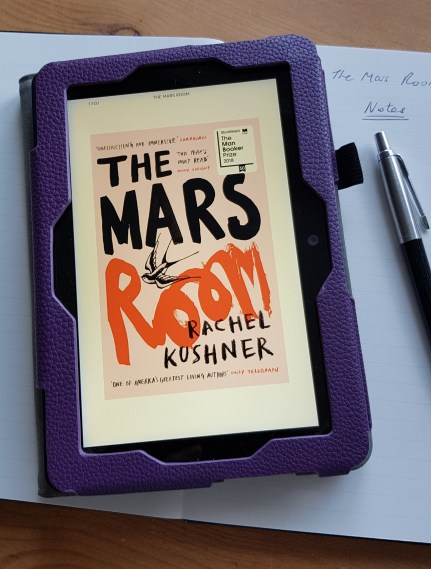
With only a few days until the 2019 Booker shortlist is announced, I think it’s fair to say that I’m running a bit behind with my reading, having just finished The Mars Room by Rachel Kushner, one of the shortlisted books from last year. I chose this one because of the title, but it’s nothing whatsoever to do with a room full of astrophysicists monitoring the Red Planet. No, the Mars Room in question, is a lap dancing club and previous workplace of 29 year old Romy Hall, about to start two consecutive life sentences at Stanville Women’s Correctional Facility, California for murdering one of her clients.

The novel opens with Romy and her fellow prisoners being transported to their destination. It’s a powerful scene that introduces us to a number of characters, people she will be spending a lot of time with. Whilst she tries to remain detached from the bizarre, often brutal, events going on around her, the reader can sense her fear. The strength of the writing is apparent from the start, the restraint, the raw uncompromising tone and the occasional rye touches of humour.

But overall it’s bleak, outlining the plight of those that are born into a world of poverty and neglect, lives lived on the margins of criminality. Romy Hall is a woman with no hope. No hope of getting out any time soon and no hope of seeing her son, Jackson. We feel for her plight and yet, she’s not a sympathetic character, nor is she intended to be. During the novel, we’re given glimpses of her past life as a stripper and mother, it’s a story of bad luck and bad choices, in equal measure.

The harsh reality of prison life is expertly portrayed – the constant hustling for bare essentials, the bickering, the boring monotony of routine tasks performed day after day. Frustration ignites into aggression, then violence, over sometimes trivial issues. It’s a place populated by survivors and those less equipped to survive, like the naïve prison educator Gordon Hauser manipulated by many of the inmates, not least Romy herself.

For many reasons it’s not an easy read. It could be argued that there are too many characters. The storyline is haphazard and meandering. The novel jumps between perspectives, between first and third person narratives. Sometimes Romy’s voice gets lost amongst all the detail. I found it difficult to keep track of it at times. The ending is abrupt.

It’s an uncompromising book, but the book that Kushner wanted to write. So if you’re looking for a conventional read with a progressive storyline then don’t read this one. I found it a challenge – but well worth the effort.

How seeing the film Yesterday got me thinking about parallel universes and all that

astronomy-constellation-cosmos-2162.jpg

Infinity and beyond

Recently I went to see the film Yesterday and thoroughly enjoyed it. If you don’t know the premise of this film it goes like this. A struggling singer/songwriter, Jack Malik, is astounded to discover that he is apparently the only person on Earth who can remember the Beatles and their music, after he wakes up in an alternative reality where they never existed, following a worldwide blackout. However something was puzzling me as I walked home. The fact that most other things in Jack’s life remain the same made me feel that the whole thing was a bit far fetched. That was until I started looking into the concept of infinity.

If you accept the idea of infinity, then parallel universes, alternate realities, or a “multiverse”, whatever name you choose to use, must exist. In other words there’s a universe out there for every outcome that is conceivable. This made the film’s plot a lot more feasible. The multiverse, a theory that a few decades ago would have been relegated to the very fringe of theoretical physics has now become quite mainstream in the world of science. This doesn’t make it any less mind-boggling.

However, the fact that Jack manages to slip into a parallel universe might still be a step too far. But, again, if you believe in infinity then Jack, and all of us for that matter, may be living in a universe that allows you to cross into other universes. Anything’s possible. And so it goes on and on and on – ad infinitum.

I was surprised to discover that there are many stories that claim to be proof of the existence of alternative realities. My favourite, because it’s such a great tale, is that of Taured Man. In the summer of 1954, a neatly-dressed, middle-aged man arrived at Tokyo International Airport. He was asked his country of origin and replied that he was from Taured. The officials told him this country did not exist. The man then proceeded to show them his passport, complete with legitimate visa stamps and a driving licence, both issued in Taured. Needing to investigate the issue further, he was sent to a hotel accompanied by two immigration officers who stood outside his hotel room, fifteen stories up, all night. In the morning he had completely disappeared. He was never seen again. Whether this was just an elaborate hoax, or proof of parallel universes, we’ll never know.

I have to confess that, lately, when I watch the news, I feel like I might have drifted into an alternative reality; or else I wish that I could! This, though, is defeatist talk. Unless there is a way to get from one universe to another, we’re stuck in the one we’ve got – warts and all. Looking on the bright side, infinity dictates that there is no other universe that has the exact version of us in it – we’re all unique. So we need to make the best choices we can, because our future in this universe is the only one we’re going to get. Unless …


Photo by Pixabay