 It could have a bright future
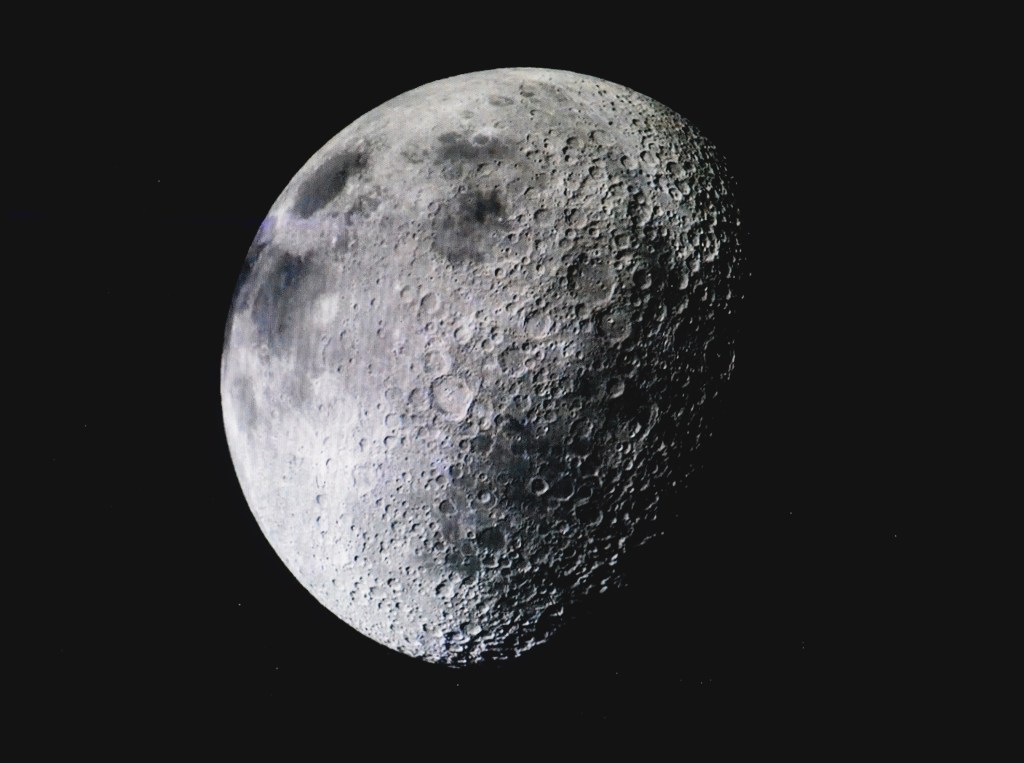
Ever since the release, in 1973, of the ground-breaking Pink Floyd album The Dark Side of the Moon with its iconic prism cover, I have been a little mystified by the exact nature of this part of our closest cosmic neighbour. In fact, for many years, I believed that it was always dark there. I don’t blame Pink Floyd for this as, despite the title, this album was more to do with mental illness than anything lunar. However, at an impressionable age, it was certainly instrumental in cementing this idea into my brain. Unfortunately, at the time, I didn’t feel the need to do any research into the topic which would have uncovered the truth. In this regard, I was not unlike our ancestors who believed that the world was flat. If it looks flat, it’s flat. If it looks dark, it’s dark.
So when China landed a robotic spacecraft on the far side of the Moon recently, I was interested to read why it appears dark to us on Earth. I discovered that it’s all to do with the fact that the Moon takes the same time to rotate on its own axis as it does to complete an orbit of the Earth. Therefore, although we never get to see it, the far side of the Moon is exactly the same as the Earth facing side and experiences daytime and night-time.
Of course there are far more exciting things about this mission than sorting out my misconceptions. For a start, the far side of the Moon is free from the radio wave pollution emanating from Earth. This could mean that if they set up a radio telescope there, it could pick up weaker signals from space. Who knows who, or what, has been trying to get in contact with us and not be able to get through.
They will also undertake some very significant research up there, increasing our knowledge of the lunar surface and its mineral make-up. In addition, the lander carries a container with potato and plant seeds, as well as silkworm eggs, so that it can perform biological studies. The plan is to see if these organisms can thrive in a controlled and contained environment on the Moon. All of which will be very helpful information if they ever decide to develop lunar tourism in the future. Or even, as pre-eminent scientist and science fiction author Isaac Asimov predicted in 1983, set up the first space colony there.
Asimov got an awful lot of things right when he was asked to give his views about what the world would be like in 2019. In particular, he got it spot on when he said that we would be governed by computers in all aspects of our lives. What he didn’t get right though was our progress in the area of space exploration, believing that we would have mining and solar power stations firmly established on the Moon by now and be well on the way to settling there. Perhaps the Chang’e-4 mission will be a major step in making his vision a reality.
 sue yockney