The Testaments by Margaret Atwood

The Testaments

History does not repeat itself, but it rhymes

Thirty-five years ago I read The Handmaid’s Tale by Margaret Atwood for the first time and it frightened the life out of me, as it did most of its female readers at the time. It portrayed a terrifying future where everything that women had fought for and achieved over centuries was taken away from them, almost overnight, with speed and brutality. I’d never read anything quite like it before.

It had a huge influence on my writing. I loved the incisive and yet lyrical quality of the prose. I liked the bravery of the ambiguous ending. I never felt the need to know exactly what happened to Offred; or to know all the answers to the many questions posed at the end of the novel. Ambiguity is unnerving. It keeps you on your toes. Like real life, sometimes you don’t get to know what happens.

I didn’t think I would, but I have thoroughly enjoyed the TV series and feel that it compliments, rather than detracts from the book it is based on. Every camera shot is a work of art. It’s like a series of Dutch genre paintings in an edgier alternative reality. Dystopia has never looked so stylish!

So it was with some trepidation that I heard that there would be a sequel to the Handmaid’s Tale after such a long time gap. I was in two minds whether to read it or not, like going back to a restaurant in which you’ve had an excellent meal, only to find that it’s been taken over by new owners and isn’t quite as good.

The Testaments follows three characters – Aunt Lydia, Daisy and Agnes – an established Aunt and well known to us from the Handmaid’s Tale, and two ‘trainee’ Aunts. The problem I had with it, right from the start, was that I found Daisy a very irritating character and this did spoil my enjoyment of the novel, since she occupies a third of it. I understand that she is supposed to be precocious having been raised in the decadent surroundings of Canada, but her dialogue grates and she descends into caricature in places. I found it almost impossible to work up any empathy towards her.

That aside, The Testaments does link very cleverly into the TV series and answers a lot of questions stemming from the original novel. But did they really need answering? I’m not sure they did. Its great strength, however, is that it provides a fascinating insight into the mind and motives of Aunt Lydia – a chilling study into the way that totalitarian societies lure ordinary folk onto a path of which they would never have felt capable.

Do I wish she hadn’t written it? No, I don’t. I really enjoyed it and feel it’s a worthy joint winner of the Booker Prize 2019. However, I do wish the judges had come to a proper decision and not copped out, leaving poor Bernardine Evaristo feeling like an ‘also ran’ at, what should have been, a defining moment of her career.

I still think that Atwood should have concentrated the whole novel on Aunt Lydia, such a great character, and left Daisy in Canada, which would also have served to sort out one of the less convincing plotlines in the novel. But there’s no getting away from it – Margaret Atwood is a class act and always has been.


The Mars Room

The Mars Room

Nothing to do with the Red Planet

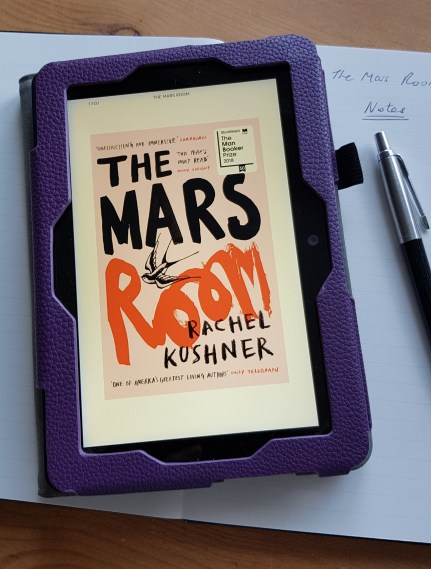
With only a few days until the 2019 Booker shortlist is announced, I think it’s fair to say that I’m running a bit behind with my reading, having just finished The Mars Room by Rachel Kushner, one of the shortlisted books from last year. I chose this one because of the title, but it’s nothing whatsoever to do with a room full of astrophysicists monitoring the Red Planet. No, the Mars Room in question, is a lap dancing club and previous workplace of 29 year old Romy Hall, about to start two consecutive life sentences at Stanville Women’s Correctional Facility, California for murdering one of her clients.

The novel opens with Romy and her fellow prisoners being transported to their destination. It’s a powerful scene that introduces us to a number of characters, people she will be spending a lot of time with. Whilst she tries to remain detached from the bizarre, often brutal, events going on around her, the reader can sense her fear. The strength of the writing is apparent from the start, the restraint, the raw uncompromising tone and the occasional rye touches of humour.

But overall it’s bleak, outlining the plight of those that are born into a world of poverty and neglect, lives lived on the margins of criminality. Romy Hall is a woman with no hope. No hope of getting out any time soon and no hope of seeing her son, Jackson. We feel for her plight and yet, she’s not a sympathetic character, nor is she intended to be. During the novel, we’re given glimpses of her past life as a stripper and mother, it’s a story of bad luck and bad choices, in equal measure.

The harsh reality of prison life is expertly portrayed – the constant hustling for bare essentials, the bickering, the boring monotony of routine tasks performed day after day. Frustration ignites into aggression, then violence, over sometimes trivial issues. It’s a place populated by survivors and those less equipped to survive, like the naïve prison educator Gordon Hauser manipulated by many of the inmates, not least Romy herself.

For many reasons it’s not an easy read. It could be argued that there are too many characters. The storyline is haphazard and meandering. The novel jumps between perspectives, between first and third person narratives. Sometimes Romy’s voice gets lost amongst all the detail. I found it difficult to keep track of it at times. The ending is abrupt.

It’s an uncompromising book, but the book that Kushner wanted to write. So if you’re looking for a conventional read with a progressive storyline then don’t read this one. I found it a challenge – but well worth the effort.

Gather the Daughters by Jenny Melamed

Gather the Daughters

Bleak but compelling

Looking recently for a novel in a similar vein to The Handmaid’s Tale by Margaret Atwood, I came across this one by Jennie Melamed, Gather the Daughters. Published in 2017, it manages to conjure up an even more bleak world than the novel that obviously inspired it.

The story is told from the point of view of four girls, living on an isolated island, and part of a quasi-religious patriarchal cult. It is assumed that the novel is set in the future but this is never stated. What we do know is that several generations ago the descendants of ten families came to the island to escape from the outside world, or ‘wastelands’, as they call it. We are not told what happened there, but we’re led to believe that some sort of disaster has taken place.

Melamed’s vivid and meticulous scene-setting may irritate those wanting to get on with the story, but it serves to draw the reader into the strange and unnerving world she’s created, making the gradual realisation of what is really happening there even more shocking. What we might believe is a simple Amish-style society turns out to have a far more sinister agenda.

The warning signs are there in the description she uses, in particular, the symbolic imagery of the island’s church erected for the worship of the islanders’ ancestors. Built with stone too heavy for the unstable foundations, it is sinking into the mud. The powers that be, rather than accept that it is a flawed building and in need of a complete rebuild, simply add more stones to the walls to restore its height and its outside appearance.

However, Melamed’s description of the island, thick with mud and mosquitoes, makes you wonder how the outside world could be any worse than the life the female inhabitants are forced to endure there. Constrained in every way by rules contained in the community’s holy book, they are forbidden from meeting together; having more than two children; and when they reach puberty they are made to to marry. Furthermore, grandmothers, when they reach the age of forty and are no longer any use for breeding and childcare purposes, are expected to ‘take the final draft’. There doesn’t appear to be any way that they can refuse to do this and so, effectively, they are coerced into commiting suicide.

Before they reach puberty, all the children of the island are given an annual reprieve from their claustrophobic existence and allowed to run free, away from their families, living outside for the whole of the summer. But this freedom gives them time, away from the scrutiny and control of their elders, to reflect on their lot.

Of the four narrators, Janey has the strongest voice. In an attempt to gain some control over her life, she has been starving herself to delay puberty and thus avoid marriage and childbirth. Branded by her entire society as mad, she has the courage to lead the girls into rebellion at the end of one of these idyllic summers. Discontented with being used as breeders and having no future to look forward to, more and more girls join in. But in a society controlled by the fathers, can the daughters ever hope to change anything?

This book is a dark and compelling read. Melamed never rushes, but rather takes her time with her gradual reveal, never explicitly saying ‘this is what’s going on’, but giving the reader enough signposts to realise the unsavoury truth.

Live screenings: it may not be the real thing – but it has it’s advantages

audience-auditorium-back-view-713149

It’s not a proper theatre experience!

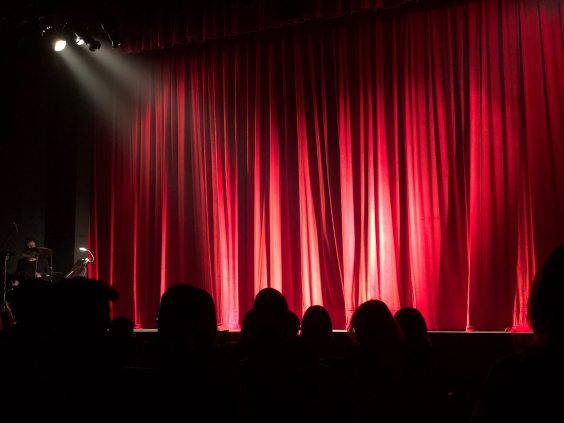
I suppose I’ve always been a bit of a purist when it comes to live performances. From music to dance to theatre, I’ve always thought the best way to experience these things is to be there in person. That was until I was persuaded to go to our local entertainment venue recently to see Arthur Miller’s All My Sons screened live from The Old Vic. Now it’s not my intention, in this blog post, to review the play itself, although it was superb. But I wondered if my reaction to it had anything to do with the way I was watching it.

I had no idea what to expect. But one thing I was sure about was that it was not going to be as good as the real thing. So when I walked in and could hear, through the speakers, the sounds of the audience arriving at the Old Vic hundreds of miles away in London, the place that I hadn’t had to travel to in order to see the play, I was a little surprised. This is not going to be a proper theatre experience, I thought, as I spotted cream teas being served up at the kiosk, curtesy of a volunteer, and no queue. But I’d got side-tracked. My husband was already at the bar, also with no queue, ordering two gin and tonics and nuts. We made our way to our pre-booked table, from different directions, and spread our goodies out in front of us.

Staring up at the screen, we watched as people battled to get to their seats, forcing more organised, disgruntled theatre-goers, in the middle of a rows, to struggle to their feet with their belongings in their arms in order to make way for the late comers. This is definitely not a proper theatre experience, I thought, as we listened to Kirsty Wark introduce the play exclusively to those viewing through live screening, giving lots of useful background information about what we were about to see. Behind her the battle for seats continued with more urgency, as curtain-up time approached.

The lights in the Old Vic and our local venue dimmed and the play began. Now this is where things really differed from what I’ve experienced before. Depending on what seats you’ve managed to get hold of, I think it’s fair to say that you rarely get a ‘perfect’ view of the stage from any of them. In the stalls, if you’re short like me, you are vulnerable to the arrival of a tall person with big hair sitting in front of you. This results in the neck wrenching necessity to keep moving your head from side to side in order to catch a glimpse of different parts of the stage. You can say goodbye to ever seeing the whole stage at any time.

If you’re lucky enough to be in the circles, then you may well have an uninterrupted view of the stage, but it’s so far away from you that the action seems very remote. This is not a proper theatre experience, I thought, as the camera zoomed in on the set, leaving the live screeners in a prime position, as if they were on the stage with the actors. Close ups provided even more intimacy. We saw every expression, every emotion throughout the whole play. At one very dramatic part of the performance, the four main characters were all crying. We saw their tears glistening in the spotlights.

Then there was the sound. Often in a proper theatre, the actors do not always project their voices enough, they do not have the same vocal strength and some actually mumble. However, with the characters being miked up for the live screening, we had no such problems and heard every word, every sigh and every whisper throughout the entire performance.

With a play as emotional and powerful as this, the quality of both the view and the sound left us stunned at the end. As the actors took their bows, it was possible to see, in their faces, the toll that the performance had taken on them. Colin Morgan, in particular, looked fit to drop. It made me truly appreciate the art of the actor. Meanwhile, oblivious to the actors’ plight, the live audience began to fight their way out of the auditorium.

So was there anything that I missed from not being there in person watching the play? Well, yes, there was. Theatres like the Old Vic are very exciting and stimulating places to be in. I missed the wait for the play to begin, looking around at the décor and the plush surroundings. I missed the ‘specialness’ of going out for a night at the theatre, getting dressed up. I missed the buzz of anticipation from the audience all around me, just before the play begins when the lights go down.

It had its pros and cons, but I was very pleasantly surprised at how much I enjoyed it. So next week I shall be booking a table for the next live screening which is a play based on one of my favourite novels, Small Island by Andrea Levy.


Photo by Monica Silvestre at Pexels

Milkman

Delivers in so many ways

Delivers in so many ways

I tend to come to things a little bit later than most. I didn’t get round to watching Game of Thrones until the end of series four. As for Breaking Bad, the whole thing was well over by the time I dipped into this brilliant piece of television. This explains why, four months after it was awarded the Man Booker Prize 2018, I have just read Milkman by Anna Burns. By distancing myself from all the hype surrounding the launch of things, I find that I approach them with fresh eyes, unaffected by others thoughts and opinions. This method does, however, have its pitfalls. There is a definite art to being a latecomer that involves the avoidance in the media, generally, and social media, in particular, of any references to interesting new films, TV programmes, books etc. that you think you might pick up on in the future. It’s possible, but not easy.

So when I started reading Milkman, all I knew about it was that it had a strange title; it was set in Northern Ireland; and was unanimously considered excellent by the Man Booker Prize judges. The novel is narrated by a girl of eighteen and is set in the late 1970’s during the Troubles. However, don’t expect any historical or political analysis or judgement because that’s not the remit of this book. This is the ‘norm’, the everyday life, for our unnamed heroine. She recounts extraordinary events in a matter-of-fact voice tinged, often, with a light touch of humour. The very first sentence sets the tone of this extraordinary novel. “The day Somebody McSomebody put a gun to my breast and called me a cat and threatened to shoot me was the same day the milkman died.” What an opening sentence!

However, it isn’t without its challenges and is quite unlike anything I’ve ever read before. It’s wasn’t the long chapters or sentences (some the length of a whole page); the minimal punctuation; the lack of paragraphs or the flow of consciousness narrative that surprised me. Although I have to admit that, in the past, I’ve given up on books that have had all, or some, of these features. What I hadn’t come across before are characters with no proper names, only denominations – like tablets girl, maybe-boyfriend, third brother-in-law, Somebody McSomebody and milkman. Some characters have more than one, like the narrator herself. The wee sisters were my favourite characters, all aged under ten and intellectual far beyond their years, who enjoy nothing more than a bit of philosophy or dipping into Thomas Hardy novels.

However, the mistake I made, from the start, was thinking that I knew exactly where the plot was going – young girl being stalked by older predatory male comes to a grisly end. Perhaps I’ve watched too many episodes of Silent Witness. So, early on, I was annoyed by the narrator’s habit of breaking off at key plot moments and taking off on long rambling and, apparently, unconnected outpourings. But be warned. Don’t even think about giving up on it at this stage. Before long, you realise that you have become totally invested in this girl’s life and predicament. The sense of place that she conjures up is so vibrant and realistic that you feel you are there beside her. You begin to be affected by the claustrophobic atmosphere, feeling trapped, with no escape from the prying eyes and caustic gossip of its inhabitants. You worry every time she sets foot out of her door. In short, you’re completely hooked.

So, yes, there’s no doubt that this book is a challenging read, but it’s well worth the journey.