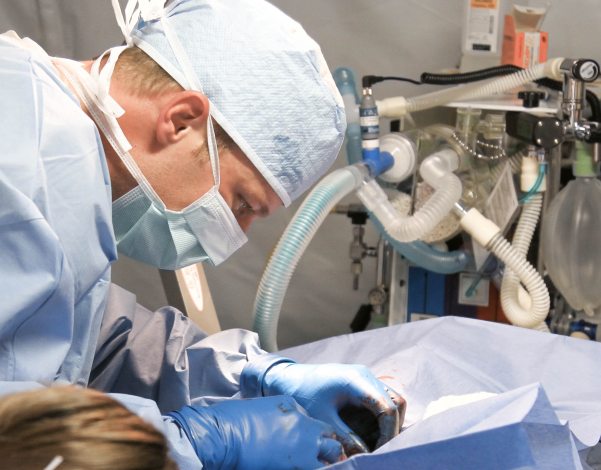
3-D printed organs: from science fiction to science fact

adult-ambulance-care-263210

It’s closer than you think.

I’ve never really given 3D printing much thought, considering it just a manufacturing process that has been around for years used to generate plastic or metal objects. That was until I read about research going on that has plucked the idea of made-to-measure organs from the pages of science fiction novels and planted it firmly into the future of mainstream medical practice. And a not to distant future, at that. It’s called bioprinting.

My immediate reaction on discovering that bioprinting existed was to wonder what, on earth, is coming out of the computer controlled nozzles when you’re bioprinting a heart. An image of liquified flesh, muscle and cartilage came to mind and it wasn’t a pretty sight. However, it turns out that it isn’t as messy as I’d imagined. In keeping with its printing heritage, it uses ‘ink’, or bio-ink as it’s referred to, made up of hydrogels, water-based solutions containing human cells. There are multiple nozzles too, some dispensing biodegradable materials to give the organs structure and strength.

The creation of human body parts like tracheas, blood vessels and damaged sections of human organs has been around for a while, so too has the ability to reproduce complex organs like skin and bladders. However, the recent news that researchers at Tel Aviv University have successfully printed the world’s first 3D heart has taken the science onto a new level. Before we get too excited, though, I feel now is the time to mention that the heart in question is small – about the size of a rabbit’s. It will be a while before the technology can create a full size transplantable human heart – but it’s close.

I think it might be a blessing that we’re a number of years away from this breakthrough in medical research, because I am not too sure that we’re ready yet for the enormous moral and ethical implications involved. Looking on the positive side, there would potentially be a lot of advantages. Organ transplants would not rely on donors. Animal testing of products could be undertaken on 3-D printed organs and not live animals. You could extend your life by replacing worn out organs. Heart disease, for example, would cease to be the killer that it is today.

However, and this is where my dystopian leanings come into play, it could lead to a lot of social problems. If people saw their bodies as disposable items that could be replaced or repaired when they became damaged, what incentive would there be to stop consuming excessive quantities of drugs and alcohol, for instance?. Why would you bother to eat a healthy diet or exercise regularly? You’d just get yourself replacement organs when needed. Your life would become something you could gamble with.

In a capitalist society, imagine if the production and distribution of bio-printed organs was in the hands of one company and the power they would wield. We already have issues with drugs companies monopolising the production of prescription drugs – it’s set to get a lot worse if you’re dealing with replacement organs. It might lead to the technology becoming the exclusive reserve of the wealthy and powerful.

Perhaps, I’m worrying unnecessarily. It could all be fine. Anyway, for now, I’ll keep my organ donor card safely in my wallet … until further notice.
The Future of Plastics

beverage-concrete-surface-drink-1146772

Ever since David Attenborough stared out at us from our TV screens at the end of the series Blue Planet II, his head at a slight angle, his expression patient but firm like a favourite uncle, and told us that we had to do something about plastic pollution in the world’s oceans before it was too late, we have taken his words to heart and set about trying to make a very complicated problem better. However, despite our good intentions, it’s not proving easy.

We’re all trying our best to recycle as much plastic as we can but, when it comes down to how much you’re able to achieve, it seems that we’re all up against a postcode lottery, due to a lack of uniformity operating in councils across the country. Some are excellent, recycling a large variety of plastic waste whilst, at the other end of the scale, a few offer only a very minimal service. Personally, I’ve got to the stage where I can’t bring myself to put any plastic into the general waste bin, so I sneak it all in the recycling hoping, perhaps naively, that something will be done with it.

There are plenty of volunteer groups who regularly remove plastic off our beaches, but it’s a never ending task – a drop in the ocean. It’s a cliché I know, but here it seems appropriate. It’s a soul-destroying activity, because the following week the shoreline will be covered in plastic waste again, as if you hadn’t done a thing. It doesn’t matter how enthusiastic you are, there’s only so many times you can do this without getting disheartened.

So what about something on a larger scale. A Dutch teenager called Boyan Slat was swimming in the sea in Greece and was appalled at what he saw there – more plastic than fish. He became an ardent campaigner determined to clean up our oceans and, in 2013, founded The Ocean Cleanup. Their plan is to deploy a fleet of long floating barriers to collect plastic in the eastern Pacific where it accumulates, trapped there by the circular currents and get rid of most of it by 2040. However, even this ambitious undertaking has it’s critics, with many making the point that, rather than spending time and money on this, we could be researching alternatives to plastic. But are there any viable, practical alternatives to plastic?

Surely the production of biodegradable plastics is the answer to the problem. Well, no, apparently not. A lot of plastics labelled ‘biodegradable’ will only break down in temperatures of 50C and that’s not going to be in the sea. They’re also not buoyant which means they sink so, as with landfill, they’re not exposed to the UV at all.

The Guardian newspaper recently decided to switch from its polythene wrappers, for its weekend supplements, to a compostable material made from potato starch. Sounds like a great idea, but feedback has suggested that the infrastructure is not always in place to support these initiatives and that some councils won’t accept them in food waste bins, as they clog up the mulching mechanisms.

It’s an interesting fact that the very first man-made plastic appeared in 1862 and was made from an organic material derived from cellulose that once heated could be moulded and retain its shape when cooled. It wasn’t until 1909 that the first completely synthetic plastic, Phenol-Formaldehyde, was invented with the trade name – Bakelite. Perhaps we should have stuck to the cellulose.

In a discussion with Prince William at the World Economic Forum, Davos, 2019, David Attenborough had this to say. “Every breath of air we take, every mouthful of food that we take, comes from the natural world. And if we damage the natural world, we damage ourselves.” With the sobering discovery of minute particles of plastic in drinking water across the world, perhaps it’s time for some joined up thinking, because we really need to get a move on now.

Dark side of the Moon


astronomy-ball-shaped-black-and-white-957626It could have a bright future

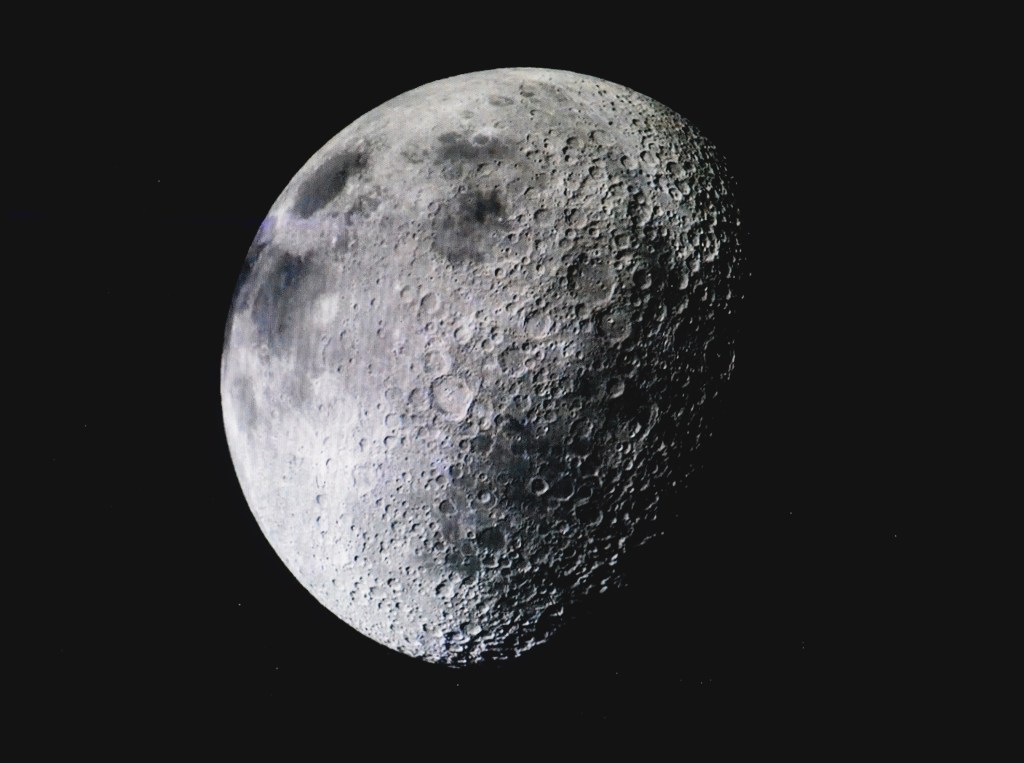
Ever since the release, in 1973, of the ground-breaking Pink Floyd album The Dark Side of the Moon with its iconic prism cover, I have been a little mystified by the exact nature of this part of our closest cosmic neighbour. In fact, for many years, I believed that it was always dark there. I don’t blame Pink Floyd for this as, despite the title, this album was more to do with mental illness than anything lunar. However, at an impressionable age, it was certainly instrumental in cementing this idea into my brain. Unfortunately, at the time, I didn’t feel the need to do any research into the topic which would have uncovered the truth. In this regard, I was not unlike our ancestors who believed that the world was flat. If it looks flat, it’s flat. If it looks dark, it’s dark.

So when China landed a robotic spacecraft on the far side of the Moon recently, I was interested to read why it appears dark to us on Earth. I discovered that it’s all to do with the fact that the Moon takes the same time to rotate on its own axis as it does to complete an orbit of the Earth. Therefore, although we never get to see it, the far side of the Moon is exactly the same as the Earth facing side and experiences daytime and night-time.

Of course there are far more exciting things about this mission than sorting out my misconceptions. For a start, the far side of the Moon is free from the radio wave pollution emanating from Earth. This could mean that if they set up a radio telescope there, it could pick up weaker signals from space. Who knows who, or what, has been trying to get in contact with us and not be able to get through.

They will also undertake some very significant research up there, increasing our knowledge of the lunar surface and its mineral make-up. In addition, the lander carries a container with potato and plant seeds, as well as silkworm eggs, so that it can perform biological studies. The plan is to see if these organisms can thrive in a controlled and contained environment on the Moon. All of which will be very helpful information if they ever decide to develop lunar tourism in the future. Or even, as pre-eminent scientist and science fiction author Isaac Asimov predicted in 1983, set up the first space colony there.

Asimov got an awful lot of things right when he was asked to give his views about what the world would be like in 2019. In particular, he got it spot on when he said that we would be governed by computers in all aspects of our lives. What he didn’t get right though was our progress in the area of space exploration, believing that we would have mining and solar power stations firmly established on the Moon by now and be well on the way to settling there. Perhaps the Chang’e-4 mission will be a major step in making his vision a reality.