Space debris: how an astronaut’s discarded glove could cause havoc

astronaut-astronomy-cosmonaut-355956.jpg

Clearing up our rubbish

It seems that wherever humans go they will always leave behind their rubbish and space is no exception to this rather depressing fact. Over 60 years of space activity has resulted in a great deal of space debris being left behind to float aimlessly in orbit around the Earth.

Current estimates indicate that there are almost 130 million objects in space of various shapes and sizes, ranging in size from a few millimetres to many metres and they can all prove hazardous. Amongst it all is known to be a glove lost by astronaut Ed White on the first American space-walk back in 1965. Even something as tiny as a fleck of paint, too small to be tracked, has the potential, when travelling at speeds of up to 17,500 mph, to cause damage. A number of space shuttle windows have had to be replaced because of paint fleck damage. And that’s just the small stuff.

Over 900,000 objects are considered big enough to damage or completely destroy entire spacecraft should they be involved in a collision. Objects like old satellites, spent rocket stages and fragments caused by their disintegration and collisions. In 2009, a defunct Russian satellite collided with and destroyed a functioning U.S. commercial satellite. The collision caused an extra 2,000 pieces of trackable debris to be added to the existing inventory of space rubbish.

NASA has well-established rules for tracking and dealing with possible collisions with such objects, including the most major of these, the evacuation of a space station. Debris avoidance manoeuvres are planned according to the probability of collision and the impact to mission objectives and risk to the crew. Over the last 10 years several collision avoidance manoeuvres have been conducted.

However the problem is not going to go away, in fact it will only get worse as more and more bits of space junk are added to what’s already up there. The only answer is to get rid of it. And that’s exactly what a 100kg satellite called RemoveDebris UK has been doing, by trialling a number of technologies that could be used in the future to deal with the clear up of space debris. The tests, using a harpoon and nets, have been successful and could open the door to a solution to the problem.

Simon Fellowes, from the Surrey Space Centre and manager of the consortium behind RemoveDebris said this, “As a university, we’ve given proof of concept for the basic ideas; we’ve shown the technology-readiness has reached a certain level. It’s now for industry to turn these concepts into a commercial product or business.”

Let’s hope that someone heeds his words and takes action before the very real prospect of space tourism becomes the norm, because that amount of debris floating about on the space highways is an accident waiting to happen.


Dark side of the Moon


astronomy-ball-shaped-black-and-white-957626It could have a bright future

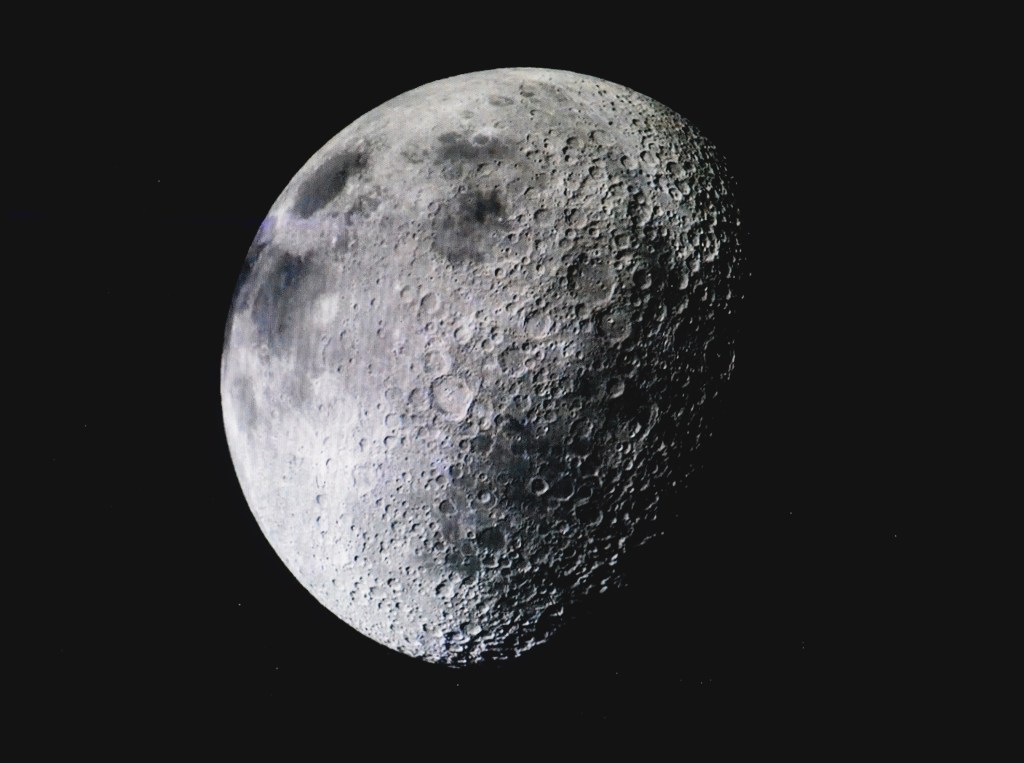
Ever since the release, in 1973, of the ground-breaking Pink Floyd album The Dark Side of the Moon with its iconic prism cover, I have been a little mystified by the exact nature of this part of our closest cosmic neighbour. In fact, for many years, I believed that it was always dark there. I don’t blame Pink Floyd for this as, despite the title, this album was more to do with mental illness than anything lunar. However, at an impressionable age, it was certainly instrumental in cementing this idea into my brain. Unfortunately, at the time, I didn’t feel the need to do any research into the topic which would have uncovered the truth. In this regard, I was not unlike our ancestors who believed that the world was flat. If it looks flat, it’s flat. If it looks dark, it’s dark.

So when China landed a robotic spacecraft on the far side of the Moon recently, I was interested to read why it appears dark to us on Earth. I discovered that it’s all to do with the fact that the Moon takes the same time to rotate on its own axis as it does to complete an orbit of the Earth. Therefore, although we never get to see it, the far side of the Moon is exactly the same as the Earth facing side and experiences daytime and night-time.

Of course there are far more exciting things about this mission than sorting out my misconceptions. For a start, the far side of the Moon is free from the radio wave pollution emanating from Earth. This could mean that if they set up a radio telescope there, it could pick up weaker signals from space. Who knows who, or what, has been trying to get in contact with us and not be able to get through.

They will also undertake some very significant research up there, increasing our knowledge of the lunar surface and its mineral make-up. In addition, the lander carries a container with potato and plant seeds, as well as silkworm eggs, so that it can perform biological studies. The plan is to see if these organisms can thrive in a controlled and contained environment on the Moon. All of which will be very helpful information if they ever decide to develop lunar tourism in the future. Or even, as pre-eminent scientist and science fiction author Isaac Asimov predicted in 1983, set up the first space colony there.

Asimov got an awful lot of things right when he was asked to give his views about what the world would be like in 2019. In particular, he got it spot on when he said that we would be governed by computers in all aspects of our lives. What he didn’t get right though was our progress in the area of space exploration, believing that we would have mining and solar power stations firmly established on the Moon by now and be well on the way to settling there. Perhaps the Chang’e-4 mission will be a major step in making his vision a reality.