Live screenings: it may not be the real thing – but it has it’s advantages

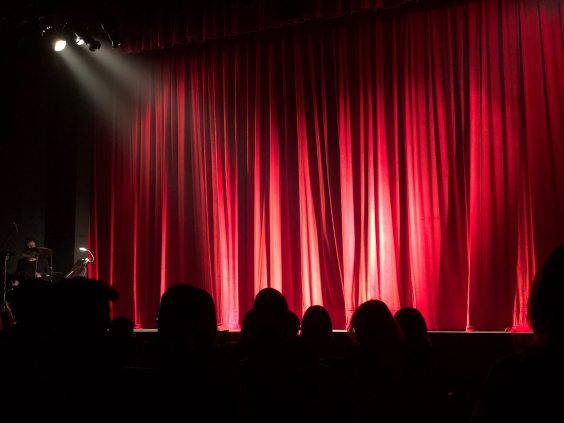
audience-auditorium-back-view-713149

It’s not a proper theatre experience!

I suppose I’ve always been a bit of a purist when it comes to live performances. From music to dance to theatre, I’ve always thought the best way to experience these things is to be there in person. That was until I was persuaded to go to our local entertainment venue recently to see Arthur Miller’s All My Sons screened live from The Old Vic. Now it’s not my intention, in this blog post, to review the play itself, although it was superb. But I wondered if my reaction to it had anything to do with the way I was watching it.

I had no idea what to expect. But one thing I was sure about was that it was not going to be as good as the real thing. So when I walked in and could hear, through the speakers, the sounds of the audience arriving at the Old Vic hundreds of miles away in London, the place that I hadn’t had to travel to in order to see the play, I was a little surprised. This is not going to be a proper theatre experience, I thought, as I spotted cream teas being served up at the kiosk, curtesy of a volunteer, and no queue. But I’d got side-tracked. My husband was already at the bar, also with no queue, ordering two gin and tonics and nuts. We made our way to our pre-booked table, from different directions, and spread our goodies out in front of us.

Staring up at the screen, we watched as people battled to get to their seats, forcing more organised, disgruntled theatre-goers, in the middle of a rows, to struggle to their feet with their belongings in their arms in order to make way for the late comers. This is definitely not a proper theatre experience, I thought, as we listened to Kirsty Wark introduce the play exclusively to those viewing through live screening, giving lots of useful background information about what we were about to see. Behind her the battle for seats continued with more urgency, as curtain-up time approached.

The lights in the Old Vic and our local venue dimmed and the play began. Now this is where things really differed from what I’ve experienced before. Depending on what seats you’ve managed to get hold of, I think it’s fair to say that you rarely get a ‘perfect’ view of the stage from any of them. In the stalls, if you’re short like me, you are vulnerable to the arrival of a tall person with big hair sitting in front of you. This results in the neck wrenching necessity to keep moving your head from side to side in order to catch a glimpse of different parts of the stage. You can say goodbye to ever seeing the whole stage at any time.

If you’re lucky enough to be in the circles, then you may well have an uninterrupted view of the stage, but it’s so far away from you that the action seems very remote. This is not a proper theatre experience, I thought, as the camera zoomed in on the set, leaving the live screeners in a prime position, as if they were on the stage with the actors. Close ups provided even more intimacy. We saw every expression, every emotion throughout the whole play. At one very dramatic part of the performance, the four main characters were all crying. We saw their tears glistening in the spotlights.

Then there was the sound. Often in a proper theatre, the actors do not always project their voices enough, they do not have the same vocal strength and some actually mumble. However, with the characters being miked up for the live screening, we had no such problems and heard every word, every sigh and every whisper throughout the entire performance.

With a play as emotional and powerful as this, the quality of both the view and the sound left us stunned at the end. As the actors took their bows, it was possible to see, in their faces, the toll that the performance had taken on them. Colin Morgan, in particular, looked fit to drop. It made me truly appreciate the art of the actor. Meanwhile, oblivious to the actors’ plight, the live audience began to fight their way out of the auditorium.

So was there anything that I missed from not being there in person watching the play? Well, yes, there was. Theatres like the Old Vic are very exciting and stimulating places to be in. I missed the wait for the play to begin, looking around at the décor and the plush surroundings. I missed the ‘specialness’ of going out for a night at the theatre, getting dressed up. I missed the buzz of anticipation from the audience all around me, just before the play begins when the lights go down.

It had its pros and cons, but I was very pleasantly surprised at how much I enjoyed it. So next week I shall be booking a table for the next live screening which is a play based on one of my favourite novels, Small Island by Andrea Levy.


Photo by Monica Silvestre at Pexels
Why I Changed My Voice

First versus Third

Who’s telling the story?

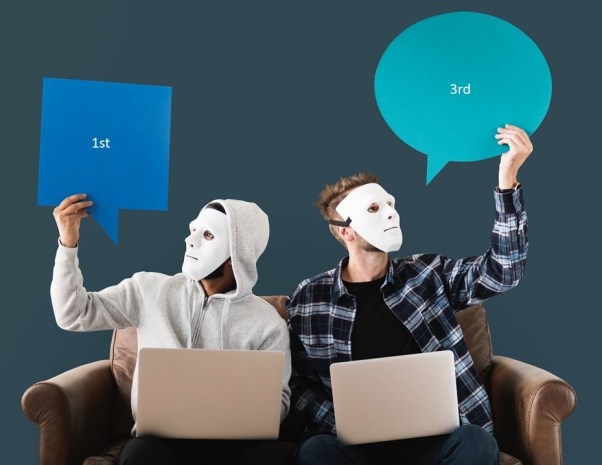
When a writer sets about creating a novel, one of the first major decisions they have to make is who will be the narrator. Who is telling the story? The choice of narrator(s) is an important one because it sets the tone, or ‘feel’, of your story. The two main types of narrator are ‘first person ‘ and ‘third person’. There are others, but they’re not so commonly used.

In the first two parts of my Happy Deathday series, I employed the first person narrative, where you use ‘I’ (or ‘We’). Set in an underground breeding colony where people are monitored day and night, I wanted to create an atmosphere of fear and claustrophobia. The reader is inside the character’s head, seeing events from their point of view and experiencing their thoughts and feelings in a very personal and intimate way. It’s most successful if the reader likes the character and forms a bond with them. However it can be limiting for the writer, as it restricts the action to one character. You can widen the reader’s experience by employing more than one first person narrative and this is what I decided to do, having my two main characters, Sarah and Jonathan, tell the story in alternate chapters. If you’re very brave you can use several first person narrators, but this is fraught with difficulty, because you have to give them all a different ‘voice’, so that the reader can tell them apart and not get confused.

In Viral City (Happy Deathday: Part 3) the story takes place in the city of Resurrection, a place undergoing dramatic and far-reaching changes. I needed the reader to be able to ‘access all areas’ and, to do that, it was essential that I changed the narrative to third person. This achieves a widening out of the action but, because events are viewed from the outside, the reader is kept at a distance. It’s often more descriptive and gives an overview of what’s happening. The downside is that it is inevitably less intimate. I really didn’t want to lose this element that I had worked hard to create in the first two parts. So what’s to be done? Well, you can create the ‘feel’ of a first person narrative by having chapters, or sections, of your book told from the point of view of a single character. You concentrate on what’s happening to that person, their thoughts and feelings. If you then do the same thing for several characters then you’ve immediately made the novel more personal. I focused on five main characters and the story is told from their points of view.

Of course, you’re overall aim as a writer is to tell a good story. If you do, then it won’t matter what narratives you’ve used or not used. In the end, the reader’s experience is the only thing that counts.


*Viral City Publication*

Viral City Full v7

I’m delighted to announce the publication of Viral City (Happy Deathday: Part 3) which is now available on Amazon in both e-book and paperback formats. It can be read as a standalone novel in its own right, or as a follow on from Parts 1 & 2 – Happy Deathday and Resurrection.

https://www.amazon.co.uk/s?k=sue+yockney&i=stripbooks&crid=35DQK47SJSY3Z&sprefix=sue+yoc%2Cdigital-text%2C139&ref=nb_sb_ss_i_1_7

22/06/3042. The Colony is no more, reduced to ashes by an inferno. What remains of it has been filled in and returned to the Earth. However, for some, the last days within its walls are not so easily erased. Now, facing an uncertain future, they must forget the past and make their way to the city of Resurrection hoping to build a new life.

But the colonists were not the only thing that escaped that day. Struggling to come to terms with the revelation that she is pregnant Sarah, alone, knows the terrible truth. A deadly mutated flu virus has been let loose after centuries of containment and is about to threaten the survival of everyone in its path.

And its arrival will set off a devastating chain of events that will have far-reaching consequences for the destiny of the whole of humanity. It must be stopped. But …

HOW CAN YOU DEFEAT AN ENEMY YOU CAN’T SEE?

Viral City (Happy Deathday: Part 3)

Viral City Full v7

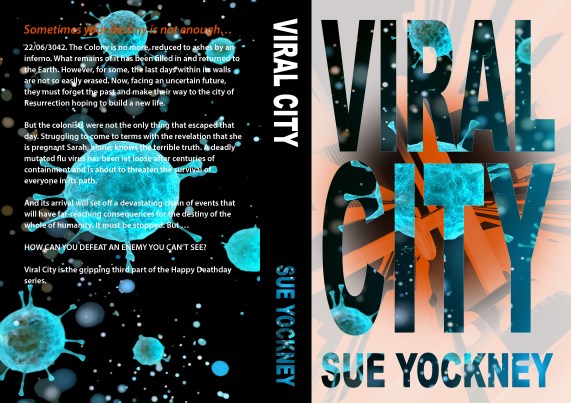
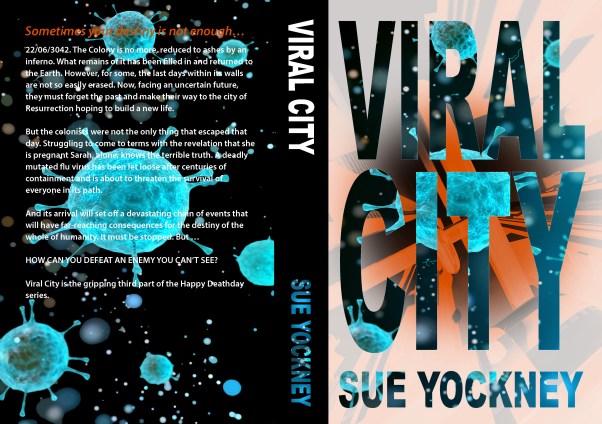
Another milestone on the road to publication! I’m very pleased to be able to reveal the full cover for the paperback version of Viral City (Happy Deathday: Part 3).

22/06/3042. The Colony is no more, reduced to ashes by an inferno. What remains of it has been filled in and returned to the Earth. However, for some, the last days within its walls are not so easily erased. Now, facing an uncertain future, they must forget the past and make their way to the city of Resurrection hoping to build a new life.

But the colonists were not the only thing that escaped that day. Struggling to come to terms with the revelation that she is pregnant Sarah, alone, knows the terrible truth. A deadly mutated flu virus has been let loose after centuries of containment and is about to threaten the survival of everyone in its path.

And its arrival will set off a devastating chain of events that will have far-reaching consequences for the destiny of the whole of humanity. It must be stopped. But …

HOW CAN YOU DEFEAT AN ENEMY YOU CAN’T SEE?


Dystopia in films & on tv – featuring worlds that have gone very wrong indeed

adult-beard-colour-2007647#2

My favourites

My novels fall into the Sci-Fi sub-genre of dystopia which can, most easily, be described as the exact opposite of ‘utopia’. A utopia is a perfect world (literally a good place) where citizens enjoy a safe existence without war, inequality, poverty and disease, free to pursue what takes their fancy in an encouraging and inspirational environment. Sounds ideal – doesn’t it? Well, yes, but unfortunately perfection is … how can I put this … a bit dull, which is why it doesn’t feature much in novels, films and tv.

Much more popular is its darker sibling – dystopia (literally a bad place). There’s no time for self-fulfilment in a dystopian society, you’re far too busy just trying to survive. Forget fair and benevolent governments, where free thought is the norm, because you’re going to find yourself ruled by controlling, oppressive regimes that use propaganda to mess with you minds. They might even resort to utopian propaganda, brainwashing you into believing that the hell you’re living in is actually not as bad as you think.

Dystopia is, in short, a lot more interesting. So, for those wanting to flip over to the dark side, here are some of my favourite films and tv series that, if you haven’t already done so, you might like to try (in no particular order). I make no apologies for the fact that most of them are based on novels or short stories.

Top Six dystopian films

  • Blade Runner (1982) & Blade Runner 2049 (2017) Yes, I know this is technically two films but I couldn’t separate them! In the 21st century, a corporation develops human clones, replicants, to be used as slaves in colonies outside the Earth. A former police officer is hired to hunt down a fugitive group of clones living undercover in Los Angeles. Director Ridley Scott’s tour de force is based on the novel Do Androids Dream of Electric Sheep by Philip K. Dick.
  • The Road (2009) In a dangerous post-apocalyptic world, an ailing father defends his son as they slowly travel to the sea. This one’s very bleak, but brilliant, based on the novel of the same name by Cormac McCarthy.
  • A.I. Artificial Intelligence (2001) A highly advanced robotic boy longs to become “real” so that he can regain the love of his human mother. A disturbing and sometimes heart-breaking film, based on a short story by Brian Aldiss called Supertoys Last All Summer Long.
  • Minority Report (2002) In a future where a special police unit is able to arrest murderers before they commit their crimes, an officer from that unit is himself accused of a future murder. Based on another short story by Philip K. Dick called The Minority Report .
  • Soylent Green (1973) In a world ravaged by the greenhouse effect and overpopulation, an NYPD detective investigates the murder of a big company CEO. Loosely based on the 1966 Sci-Fi novel Make Room! Make Room! by Harry Harrison.
  • Twelve Monkeys (1995) In a future world devastated by disease, a convict is sent back in time to gather information about the man-made virus that wiped out most of the human population on the planet. Based on Chris Marker’s short film called La Jetee.

Top Six dystopian TV series

  • Battlestar Galactica (2004 – 2009) Following the destruction of the Twelve Colonies of Kobol by the Cylons, a rag-tag fugitive fleet of the last remnants of mankind flees the pursuing Cylons while simultaneously searching for their true home: Earth. A rip-roaring and totally compelling series.
  • Westworld (2016 – ) Set at the intersection of the near future and the reimagined past, it explores a world in which every human appetite can be indulged without consequence. This has a stellar cast including the wonderful Thandie Newton and Ed Harris. Inspired by the 1973 film of the same name, starring Yul Brynner.
  • Handmaid’s Tale (2017 – ) Set in a dystopian future, a woman is forced to live as a concubine under a fundamentalist theocratic dictatorship. Based on the 1985 novel, of the same name, by Margaret Atwood, a book that had a huge influence on my own writing.
  • The 100 (2014 – ) Set ninety-seven years after a nuclear war has destroyed civilization, a spaceship housing humanity’s lone survivors sends one hundred juvenile delinquents back to Earth, in the hope of re-populating the planet. Based on the novels of Kass Morgan.
  • Black Mirror (2011 – ) Created by Charlie Brooker, this is an anthology series exploring a twisted, high-tech world where humanity’s greatest innovations and darkest instincts collide. As you would expect from Brooker, this is weird and wonderful in equal parts.
  • The Walking Dead (2010 – ) Sheriff Deputy Rick Grimes gets shot and falls into a coma. When he awakes, he finds himself in a Zombie Apocalypse. Not knowing what to do he sets out to find his family. How much I love this series is a surprise even to me, because I am no fan of zombies! But then this show isn’t about the zombies. It’s all about survival, the risks, and the things you have to do to stay alive. After one episode, I was hooked.

So is there anything new in dystopia coming up in 2019. Well, yes there is. There’s a film starring John Goodman called Captive State set in a Chicago neighbourhood nearly a decade after an occupation by an extra-terrestrial force. Release date for this is 29th March.

On tv, there’s a new series for 2019 entitled Dystopia (no screening date as yet) which has an attention-grabbing strapline – ‘In our future all the children are dying. We have the ability to save them. All we have to do is kill everyone else.’ You can’t get much more dystopian than that!