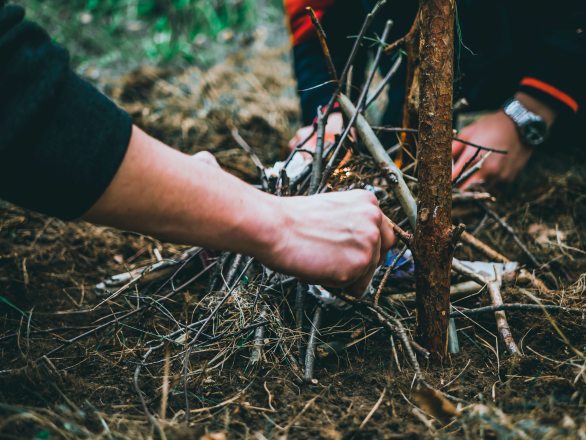
“The instinct in humans and animals to do things that will prevent them from dying” – this no frills dictionary definition of the word ‘survival’ tells it like it is. So does this basic instinct, that has served humankind so well for millennia, still work for us in the 21st century? Of course, the answer is yes, but in an adapted way to suit the far more complex and sophisticated world that we live in. Although the environment has changed beyond recognition from the fight or flight days of our ancestors, human needs for survival haven’t. They remain constant – shelter, food and water, and clothing to protect our bodies from extremes of temperature and other hazards. However, it only takes an unexpected event or accident to throw a person out of their comfort zone and into survival mode.
At the end of last year, I broke my right wrist on holiday in Finland. Now I know that you can’t blame everything on climate change, but it did have a role to play in this. Usually in November, northern Finland (Lapland) is covered in a thick layer of powdery snow. However, in the week before we arrived, due to unprecedented high daytime temperatures, the snow had melted and then frozen in the sub-zero temperatures at night, resulting in solid sheets of ice everywhere. The choice was simple, stay inside and not venture out at all, or put crampons on your boots and take your chances. I did the latter! On the plus side, I did get to see the aurora on four nights – which was spectacular.
So there I was in a foreign country, in arctic conditions, with my right arm plastered up to my elbow. My first reaction was to burst out crying in an unashamed wave of self pity. However, after I’d got over the initial shock of what had happened and taken a few industrial strength painkillers, my survival instinct began to kick in. I realised that I needed to think about the situation in a calm and methodical way.
Being right-handed, a considerable number of things that I had previously taken for granted became a real problem. Most of the clothes that I’d brought with me became obsolete straightaway, as I was unable to get the plaster through the cuffs. This included my duck down coat, essential for surviving the freezing temperatures. Preparing and cutting up my food was impossible, as I couldn’t apply any pressure on my wrist. Trying to do this one-handed doesn’t work, I tried it many times. You need a knife and fork to get this right. At least I had a cabin for shelter, but I couldn’t light a fire.
In short, if I’d been on my own, I would have had to return home. However, even that would have been far from straightforward, trying to negotiate my luggage, getting in and out of vehicles and doing all the travel-like things that are difficult even if you have all your limbs intact. Instead I decided to stay the course with the help of my husband.
I reverted back to toddlerhood. Buttons and zips were done up for me. My food was cut up into bite-size pieces, or else, in a fit of frustration, I’d pick it up with my left hand, even in restaurants, people making allowances for me, seeing my predicament. It was surprisingly liberating to be excused the usual table manners. As for my clothes, I sacrificed a number of items by splitting the right arm seam. Most important, I discovered that I could still get my coat done up if I pushed my hand up to, but not through, the cuff.
So I survived. Well, of course I did. However, the whole experience made me give more thought to those with permanent disabilities who have to face these challenges every day of their lives and to the large number of people who, even in the 21st century, struggle to gain access to even the basic survival needs.
 sue yockney